Understanding AI Wrapper: The Faster Way to Build Intelligent Products
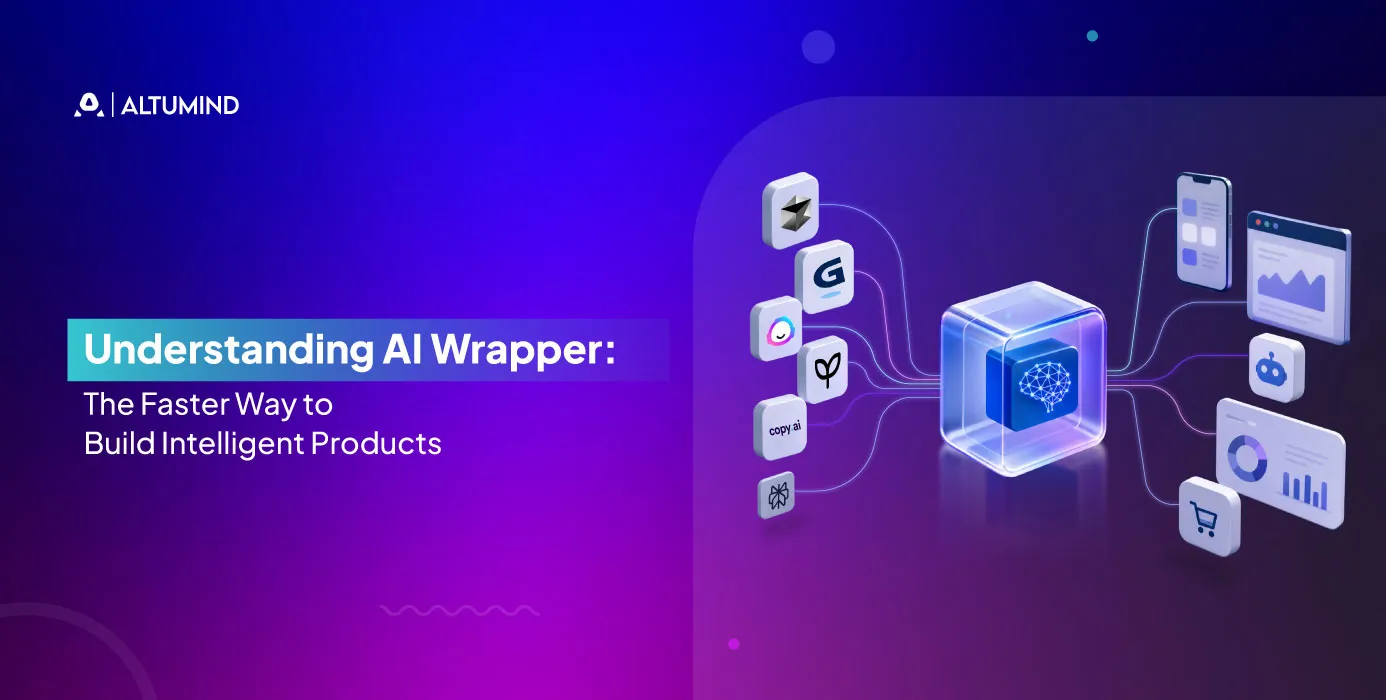
Building software used to require months of development and significant capital. Today, businesses ship intelligent products faster by placing a designed layer on top of existing AI models. That layer is called an AI wrapper.
Understanding what an AI wrapper is has become increasingly relevant for founders and enterprise leaders. Some of the questions organizations face at this stage include:
- Investing in AI without clarity on what to build versus what already exists.
- Attempting to compete with foundational model providers rather than building on top of them.
- Spending on custom AI infrastructure when a well-designed AI wrapper delivers faster results.
- Overemphasis on technology rather than user needs often leads to poor product-market fit.
- Underestimating the business value a well-positioned AI wrapper can create.
Keep reading as we examine what AI wrappers are, how they work, real-world examples, and how to build one that delivers lasting value.
What Is an AI Wrapper
An AI wrapper is a product built on top of a foundational AI model. Examples include GPT-4, Claude, Gemini, and Llama. It adds a customized interface, specific workflows, and domain-specific context. This makes the underlying model useful for a particular audience or use case.
The foundational model provides the underlying intelligence. The AI wrapper defines how that intelligence is contextualized, governed, and delivered to end users. This covers how users interact with the model and what context it receives. It also shapes how outputs are formatted and how the product fits into a broader workflow.
A useful way to understand this is to view foundational models as core infrastructure. The AI wrapper is the application layer built on top of that infrastructure. It determines who can access it, how it behaves, and what value it delivers. Most users cannot interact with the infrastructure meaningfully without a well-designed AI wrapper. And without the infrastructure itself, the AI wrapper has nothing to build on.
Why AI Wrappers Matter Now
Foundational models are now accessible through APIs to teams of any size. Organizations no longer need to train models from scratch. They need to understand users deeply and connect the right model to the right workflow.
This shift changes how businesses approach digital product development. It changes how quickly they can move from idea to market. The distinctions between agentic AI and generative AI matter here too. The choice of underlying model shapes what the AI wrapper can meaningfully offer.
How an AI Wrapper Works
At its core, an AI wrapper operates through a series of structured interactions between the user, the AI wrapper layer, and the underlying model. Understanding this architecture helps product teams make better decisions about where to invest in development effort and where the model handles heavy lifting.
The Core Architecture
An AI wrapper operates through structured interactions between the user, the AI wrapper layer, and the underlying model. Understanding this helps product teams decide where to invest in development efforts.
The process follows this sequence. Each layer represents a distinct product decision:
- User Input Layer: The user interacts through a web app, mobile app, voice interface, or API. This layer determines how intuitive the product feels to its audience.
- Prompt Engineering Layer: The AI wrapper translates user input into a structured prompt. It frames the request to produce reliable outputs consistently.
- Context and Memory Layer: The AI wrapper injects user history, domain knowledge, and business rules into the model’s input. This makes responses feel relevant rather than generic.
- Model API Call: The structured prompt is sent to the foundational model via API. The model processes it and generates a response.
- Output Processing Layer: The AI wrapper formats, filters, or validates the raw model output. Raw outputs are rarely production-ready without post-processing.
- User Experience Layer: The formatted output is presented in a natural, actionable way. This determines whether the user derives immediate value.
The Role of Prompt Engineering
Prompt engineering is critical and often underappreciated. It is the practice of designing instructions and constraints sent to the model. The goal is to produce reliable, high-quality outputs across varied user inputs.
A poorly designed prompt produces inconsistent or generic outputs. This erodes user trust over time. A well-designed prompt makes the model behave like a domain specialist. It produces outputs that feel tailored and practically valuable.
For businesses building AI wrappers, prompt engineering is a core product competency. It directly impacts user satisfaction, output quality, and retention. Teams that invest in prompt design before launch produce more reliable products.
Types of AI Wrappers
AI wrappers span a wide range of applications. They differ by interaction model, domain, and business objective. Understanding the types helps organizations identify the right approach before committing to development.
1. Conversational AI Wrappers
Conversational AI wrappers build natural language interfaces on top of foundational models. Users ask questions, generate content, or complete tasks through dialogue. What separates a strong conversational AI wrapper from a generic chatbot is context. The AI wrapper knows who the user is and what they have asked before. It shapes every response accordingly. Customer support tools, writing assistants, and enterprise copilots all fall here.
2. Voice AI Wrappers
Voice AI wrappers combine speech recognition, a language model, and text-to-speech synthesis. They create products driven entirely by spoken interaction. The complexity sits in the AI wrapper layer. It manages latency, accent handling, and speech synthesis quality. This category is expanding across healthcare, automotive, and customer service.
3. Vertical SaaS AI Wrappers
Vertical SaaS AI wrappers serve specific industries. They add domain knowledge, compliance awareness, and professional output formatting. The differentiation comes entirely from the AI wrapper, not the model. This is why vertical AI wrappers command premium pricing and stronger retention. The growing influence of AI in compliance-heavy industries makes this category significant for enterprise buyers.
4. Workflow Automation AI Wrappers
These AI wrappers embed AI into existing business processes. They connect foundational models to CRMs, ERPs, and document systems. Common applications include automated report generation and intelligent document routing. Organizations investing in AI automation services frequently start here. Return on investment is measurable, and implementation scope is well defined.
5. Multimodal AI Wrappers
Multimodal AI wrappers accept multiple input types. They produce outputs across different formats, from text and images to audio and video. The AI wrapper manages coordination between input types and model capabilities. It presents a unified experience regardless of underlying complexity.
7 Real-World AI Wrapper Examples
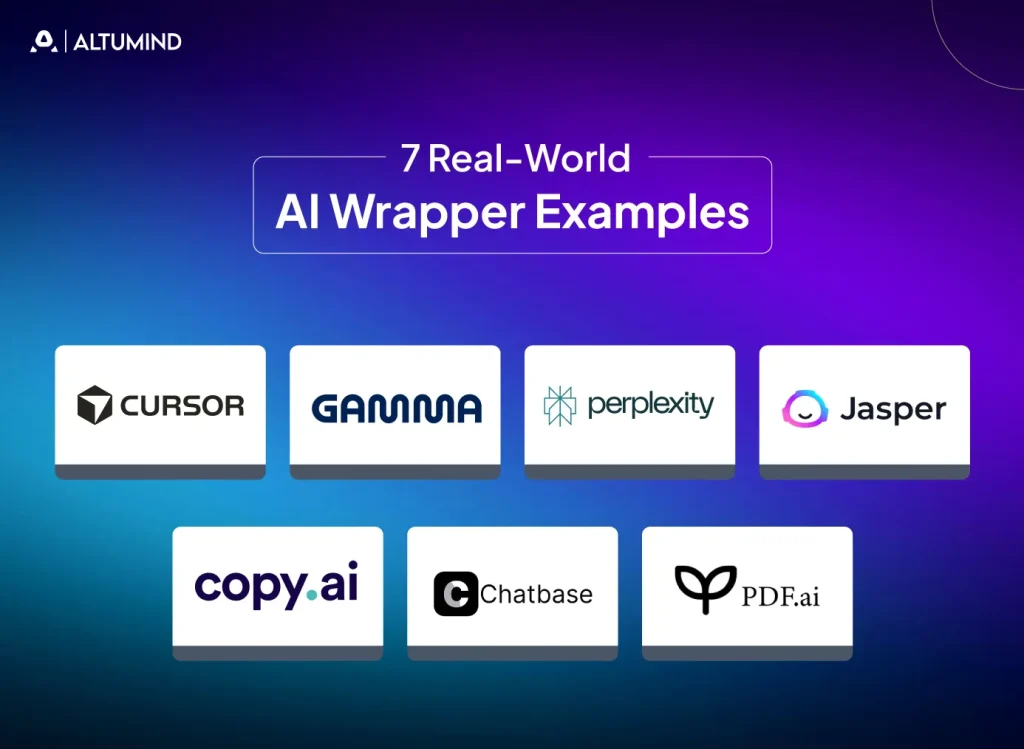
The following are among the most commercially significant AI wrapper products globally. Each demonstrates a distinct approach to building value on top of foundational models.
1.Cursor
Cursor is an AI-native code editor built on Claude and GPT-4. It wraps the model within a full development environment. The model has access to the entire codebase as context. Cursor emerged as one of the fastest-growing AI-native development platforms. It demonstrates how a well-designed AI wrapper can create an entirely new product category.
2.Gamma
Gamma wraps large language models within a web-native presentation builder. It generates formatted decks from a text prompt in under 90 seconds. It adds design intelligence, layout logic, and brand consistency controls. The differentiation is the AI wrapper’s design intelligence, not the model.
3.Perplexity AI
Perplexity wraps multiple foundational models with real-time web retrieval and source citation. It adds a conversational research interface that no language model provides independently. Perplexity demonstrates how a well-built AI wrapper can redefine an entire product category through retrieval and context design.
4.Jasper AI
Jasper wraps OpenAI’s models with marketing-specific templates and brand voice controls. It adds tone configuration and campaign workflow tools. The product experience and workflow design are the differentiators, not the underlying model. Jasper demonstrates how product-layer differentiation creates a defensible business.
5.Copy.ai
Copy.ai began as an AI writing wrapper. It evolved into a go-to-market automation platform. It wraps language models within GTM workflows covering content creation and CRM updates. Its trajectory demonstrates how deeper workflow embedding makes an AI wrapper progressively harder to replace.
6.Chatbase
Chatbase allows businesses to create custom AI chatbots trained on their own data. It uses a retrieval augmented generation architecture. The AI wrapper manages data ingestion, vector storage, and contextual retrieval. It demonstrates that niche focus and strong distribution matter more than technical complexity.
7.PDF.ai
PDF.ai wraps GPT with document retrieval and question-answering capabilities. Users interact with PDF content through natural language. The AI wrapper manages document parsing, content chunking, and vector retrieval. It scaled through SEO-focused distribution with exclusive focus on one clearly defined problem.
How to Build an AI Wrapper?
Building an AI wrapper requires product thinking, user research, and thoughtful technical architecture. These must work together from the earliest stages of development.
1. Start With the User Problem
The most common mistake is beginning with the model rather than the user. The right question is what problem a specific group of users has. And whether AI can solve it better than existing solutions.
This is where product discovery plays a defining role. Understanding user workflows before writing code determines whether the product finds an audience.
Before committing to development, answer three questions:
- Who exactly is the user: A specific person with a specific frustration, not a broad category.
- What are they doing today: Understanding where the current tools fall short and what workarounds they use.
- Why would AI solve it better: Speed, accuracy, cost reduction, or consistency are valid answers.
Strong AI wrapper products are defined by deep user understanding, not model sophistication.
2. Define What the AI Wrapper Adds
Teams should articulate clearly what the AI wrapper contributes beyond the foundational model. An AI wrapper that only adds a cleaner interface carries significant competitive risk. Differentiation based solely on interface design is relatively easy for competitors to reproduce.
The most defensible AI wrappers add multiple layers of value:
- Domain-Specific Context: Industry knowledge and compliance constraints injected into every interaction.
- Workflow Integration: Direct connections to tools users already work within daily.
- User Experience Design: An interface accessible to users who would never use a raw model API.
- Memory and Personalization: Remembered preferences and context that improve the product over time.
- Output Formatting: Responses structured into immediately actionable professional formats.
3. Choose the Right Foundational Model
The model choice should follow the use case requirements, not precede them. Key considerations include the following:
- Task Suitability: Match model strengths to the primary task. Some excel at reasoning. Others are at creative generation or coding.
- Latency Requirements: Voice AI wrapper products need low-latency models. High latency significantly degrades the conversational user experience.
- Context Window Size: Long document products need large context windows. Insufficient capacity creates fundamental limitations.
- Cost at Scale: Calculate unit economics at projected query volumes before committing to a model.
- Privacy and Data Handling: For regulated industries, the model provider’s data policies matter as much as capability.
Following a structured roadmap for SaaS product development helps frame model selection within a broader product strategy.
4. Design the Prompt Architecture
Prompt architecture governs how the AI wrapper communicates with the model. It is invisible to users but defines every response the product delivers. A robust prompt architecture includes the following:
- System Prompts: Persistent instructions defining the model’s role and behavioral boundaries.
- Context Injection: User data and business rules provided to the model at each query.
- Output Constraints: Instructions on format, length, and tone, ensuring usable outputs.
- Guardrails and Safety Layers: Instructions protecting users from harmful or non-compliant outputs.
- Error Handling Logic: Defined responses for ambiguous inputs or out-of-parameter outputs.
5. Build Iteratively Based on Real Usage
AI wrapper products improve through real usage data. Initial designs rarely survive contact with actual users unchanged.
Building in short cycles addresses this directly:
- Prompt Testing Across User Types: Different users phrase the same request differently. Test across varied real inputs before launch.
- Output Quality Monitoring: Track whether users edit, discard, or act on responses. This signals genuine value delivery.
- Usage Pattern Analysis: Identify which features users engage with most and which workflows they abandon.
- Feedback Loop Integration: Allow users to flag poor outputs directly. This creates a continuous signal for improvement.
This iterative approach aligns with sound digital product development thinking. It prioritizes learning before scaling infrastructure investment.
When an AI Wrapper Is the Right Strategic Choice
Not every AI product should be an AI wrapper. The right strategy depends on resources, timelines, and differentiation requirements. It also depends on the maturity of available foundational models for the specific use case.
AI Wrapper Is the Right Choice When
An AI wrapper is the right strategic choice in these situations:
- Foundational models already perform the core intelligence task well enough. The remaining differentiation lies in experience, context, and integration.
- Speed to market is a priority. Multi-year custom development timelines create a meaningful competitive disadvantage.
- Business differentiation lies in user experience, domain knowledge, or workflow integration. It does not depend on proprietary AI capabilities that must remain exclusive.
- The team has stronger product and design capability than machine learning engineering expertise. The AI wrapper layer is a natural area of competitive strength.
- The use case requires rapid iteration based on user feedback. Long model training cycles slow the product’s ability to respond to real-world learnings.
Custom AI Development May Be More Appropriate When
Custom development is worth considering in these specific situations:
- The use case requires capabilities no existing foundational model handles adequately. The gap cannot be closed through prompt engineering or retrieval augmentation alone.
- Data privacy or regulatory requirements prevent sending user data to third-party model APIs. On-premise deployment is not commercially viable either.
- The AI capability itself is the core competitive differentiator. It must remain proprietary to protect the product’s primary value proposition.
- The projected volume of model API calls at scale makes external API economics unfavorable. Self-hosted alternatives offer better total cost of ownership at that volume.
Many organizations begin with an AI wrapper to validate product-market fit quickly. They invest in deeper custom development once the opportunity is commercially proven. This sequencing makes strategic and financial sense for most teams.
The Business Case for AI Wrappers
The commercial opportunity in AI wrappers is significant across virtually every industry. A well-positioned AI wrapper in an underserved vertical can build substantial recurring revenue. It does not require the infrastructure investment of a foundational model provider.
Where the Value Is Created
The value in an AI wrapper business compounds over time as the product matures. It comes from four primary sources:
- Workflow Integration Depth: The more deeply an AI wrapper integrates with daily tools and processes, the higher the switching costs. Products embedded deeply within operational workflows are significantly harder to replace than peripheral tools.
- Domain Expertise: AI wrappers built by teams with genuine domain knowledge produce better outputs. They earn stronger professional trust. Professional users notice the difference between a product that understands their domain and one that simply passes queries to a general model.
- User Experience Quality: Multiple competing products often use the same underlying model. In that market, interface design, workflow logic, and reliability become primary differentiators. Users choose the product that makes them most productive.
- Data Network Effects: AI wrappers that improve through accumulated user data develop compounding advantages. New entrants find these positions genuinely difficult to replicate quickly. Scale becomes a barrier to competition over time.
The most commercially successful AI wrapper businesses share a consistent pattern. They are not those using the most advanced models. They are those that understand a specific user most deeply. They have designed the most thoughtful and integrated experience around that understanding.
Conclusion
AI wrappers are one of the most commercially accessible approaches to building AI-powered products in 2026. They allow teams to move quickly and focus on user experience and domain expertise. They create genuine business value without foundational model infrastructure requirements.
The examples from Cursor to Perplexity show a consistent pattern. The most successful AI wrappers are not defined by which model they use. They are defined by how deeply they understand their users. The model provides intelligence, and the AI wrapper provides the value.
Altumind’s digital product development services support organizations at every stage of this journey. From early product discovery through to full-scale AI wrapper development and ongoing optimization. Connect with our team today to discuss your AI product vision and take the first step towards building something that genuinely serves your users.